Stories from Sergei
Priesthood
"... you yourselves as living stones are being built up into a spiritual house to be a holy priesthood, in order to offer up spiritual sacrifices acceptable to God through Jesus Christ" - 1 Peter 2:5
"... you are “a chosen people, a royal priesthood, a holy nation, a people for special possession, that you should declare abroad the excellencies” of the One who called you out of darkness into his wonderful light." - 1 Peter 2:9
My perception of the priestly duties of the anointed did not arise suddenly or recently. I can trace its formation back to 1996. I know this not because I remember every detail precisely, but because I have studied The Watchtower diligently for more than 31 years, and certain frameworks, once formed, continue to shape perception even when their origin fades from memory.
Looking back now, the July 1, 1996 Watchtower article on Jehovah’s great spiritual temple appears to have played a decisive role in shaping that early understanding. From that time on, I consistently viewed Jehovah’s organization through temple imagery. The sheep were not merely visitors; they were pictured in my mind as acceptable sacrifices entering Jehovah’s temple. The organization itself appeared to me as the inner courtyard of the great spiritual temple—a place of cleansing, dedication, and service.
What I did not yet have at that time was a clear, experiential perception of the anointed serving within the Holy. That understanding came later—not through theory, but through lived experience. Only after personally passing through what I can describe as a death of the old personality and a spiritual resurrection as a new creation did the imagery of the Holy place become meaningful from the inside rather than from observation.
In recent years, I have cautiously shared this perception only with those who seemed to have “ears to hear.” What I noticed—without surprise—was that only anointed Christians were able to process this framework meaningfully. Others listened respectfully but could not internalize it in the same way. This was not a matter of intelligence or spirituality, but of calling and perception.
When I eventually had the opportunity to discuss this with an anointed brother—whom I will call Mario to protect his identity—I encountered disagreement. For him, priestly service belongs entirely to the future, after death and resurrection in heaven. In his view, present responsibility is defined almost exclusively by preaching.
I see it differently.
I do not deny the future aspect. I agree that kingship and full glorification are future realities. Where we differ is in timing and definition. For me, priestly service is not postponed entirely to the afterlife. It is already active now, though in a provisional and preparatory form. The decisive transition is not physical death, but the death of the old personality and the spiritual rebirth that Scripture describes as becoming a “new creation.”
From that point on, responsibility changes in nature. Preaching remains essential, but it is no longer the only expression of service. Shepherding, intercession, spiritual care, bearing others’ burdens, guiding consciences patiently, and preserving spiritual health become central. These are not administrative roles, nor positions of authority, but priestly functions—quiet, inward, often unseen.
Just to keep the timing clear, I want to note that this recent discussion came out of a cluster of messages we exchanged periodically beginning January 4, 2026. Mario and I have known each other for about three years, and during that time we have genuinely enjoyed exchanging spiritual thoughts.
The subject of priesthood itself is not new in our conversations. We have discussed it before, and I clearly remember how open Mario was to considering it from a different angle. What made this recent exchange different was not the topic, but the timing.
This time, our conversation exposed a radically different perception of when priestly services are performed by anointed Christians. For Mario, priestly service is something reserved entirely for the future—after death and resurrection in heaven. For me, priestly responsibility is already being exercised now, while still in the flesh, though not yet in its final kingly expression.
That difference in timing—not loyalty, not respect for Jehovah’s arrangement—is what brought the tension into focus.
The Essence of My Message to Mario:
Why I Understand My Calling Through the Priestly Framework
"To be completely transparent, the priestly perception of the holy place in the spiritual temple, as well as the inner court services, resonated in my heart for many years before I would ever consider this as part of my personal anointing. I did see the anointed in this capacity, and even the entire congregation in an extended sense. We are all sheep in Jehovah’s courtyard for worship, and it is there that determinations are made regarding who is qualified to serve Jehovah.
The priests placed their hands on sheep, goats, and bulls—to slaughter them or to send them into the wilderness. Some were rejected as not acceptable for sacrifice. Who determined whether they were qualified? The priest did. For me, this was full of symbolism. It was one of those puzzle pieces that, over time, helped me identify myself as someone who had worked in the inner court for many years.
Later, my senses began to perceive my presence inside the holy place —eating from the showbread in a way not permitted for other sheep, a liberty allowed only to sons. Even my imperfection was no longer a hindrance; I felt redeemed. I felt the love Jehovah poured into my heart. When I began hearing the calling, it confirmed the meaning of what I had already sensed.
You know how our publications compare the inner court and the holy place with the condition of the anointed. For me, however, the most meaningful element was sonship. I experienced a transformation not only in my feelings toward Jehovah as Father, but—more importantly—in His expression of fatherly love toward me as His son. This is where “Abba, Father” became central to my relationship with Jehovah.
My prayers then became more than personal petitions. They expanded to include prayers on behalf of all people, for our brothers, and for the sanctification of Jehovah’s name. This felt connected to something even more specific—what the high priest alone was allowed to do when stepping behind the curtain to redeem the people from their sins. “Forgive us our sins, as we forgive those who sin against us.” This became very personal to me.
Like Joseph and Jesus, I experienced betrayal from those I loved, cared for, and sacrificed myself for. The entire spectrum of the model prayer became my own. It became a fully prepared holy incense —something permitted only behind the curtain—to redeem not only those who betrayed me, but others as well.
Jesus, after his baptism, was not only a Lamb—he became the High Priest. I already shared with you how he was baptized on the Day of Atonement, the day when the high priest was allowed to step behind the curtain. As we know, the heavens were opened for Jesus. I sense them opened for me as well. It is hard to express fully, but just as Jesus heard the voice of approval, I hear Jehovah’s voice expressed through his Son, the Word, in a new way—not merely as instruction, but as calling, or rather, communion.
Through this, I began sensing Jehovah’s love for all people in a new way. His purpose to redeem mankind for everlasting life on earth became sharper through this heavenly communion.
“My heart is stirred by something good. I say: ‘My song is about a king.’ May my tongue be the stylus of a skilled copyist.”
This was an undeniable confirmation of my personal anointing, and priestly perception became more meaningful to me than anything else.
As you know, calling is more than perception. It is communion with Jehovah and Jesus, something described quite precisely in the inspired expressions of the Scriptures. In this conversation, we are touching on matters that have not yet been expressed clearly by the faithful slave. That does not trouble me. The spirit searches into the deep things of God—and searching does not mean immediate revealing.
The faithful slave encourages us to search for deep spiritual things, and we see that even reflected in the theme text for 2026. I am personally grateful that we live in a time when fear of being judged no longer blocks the road for a sincere spiritual journey into the deep things of God. Where Jehovah’s spirit is, there is freedom.
At the same time, we know that many have gone through this journey before us, and their searching has been consolidated in the Bible and in the publications of the faithful and discreet slave. These are solid anchors that protect us from drifting away. Still, we know which authority dominates. Our publications themselves show that understanding can change over time as God’s Word is given priority in shaping perception. The faithful slave does not claim to be prophetic or infallible, and therefore there is room for personal searching.
As I mentioned, I tend to circle around themes and terminology, allowing inner connections to form. This helps me perceive Jehovah’s mind more clearly. These are the most enjoyable discoveries for me, because His thinking goes deep. The Scriptures say that the spiritual person discerns all things, yet such a person is not easily judged by others.
You, I, and the anointed brothers who have received the assignment to feed and shepherd those entrusted to us—we all at times uncover insights that are not immediately obvious to others. Often, only the spirit confirms that something is true, even if only conditionally at first. I also appreciate that brothers on the Governing Body themselves experience moments of discussion and refinement, as Brother Jeffrey Winder mentioned in the annual meeting talk “How Does the Light Get Brighter?”
So, returning to the priestly perception of the services: I acknowledge your point. At the same time, I have an undeniable inner conviction that I personally experience communion with Jehovah and Jesus comparable to what was represented by the priests—those who were allowed to hear what the spirit teaches and reveals. This is something very personal, just as you once told me when we spoke at Michael's house.
If you don’t see it the way I see it, that simply reflects personal communion. And unless the faithful slave publishes something on it, there is no need to worry about it—because we will always settle matters in unity.
As you can see, I perceive my calling largely within the framework of priestly service. I hope I answered your question."
My following message to Mario
"I’ve been thinking more about our conversation, especially the distinction between priestly service and kingship, and I wanted to share one simple observation that helped me personally.
When I look at the Scriptures, I notice that kingship is always spoken of as future, while priestly service is described as something exercised now. Even Paul corrected the Corinthians for acting as if they were already ruling, saying he wished they had begun ruling so that he could rule with them as well—clearly placing rulership ahead in time.
At the same time, the Christians Greek Scriptures repeatedly speaks of Christians as already functioning in a priestly way: offering spiritual sacrifices, interceding in prayer, presenting themselves as living sacrifices, and having boldness to enter the holy place. All of that is present-tense language. It describes access, communion, and service—not authority or rulership.
That distinction helped me understand why priestly imagery resonates so strongly in the present Christian life, while kingship remains something we wait for. It also fits the bride picture: the bride is chosen and prepared now, but she becomes queen only after the marriage.
I’m not presenting this as a conclusion, only as an observation that brought balance to my thinking. I’d be interested to hear how you see this distinction when you read the same passages."
My friend Mario, cannot share my perception and felt that I have to drop it. Pray to Jehovah and leave in his hands. I went through the following analysis, but didn't feel compel to share with Mario
From Mosaic priesthood to Christian congregation —
assistance, not domination
When Jehovah introduced the priestly arrangement through Moses, He established distinct roles within sacred service, not to elevate individuals, but to preserve order, access, and communion.
Under the Law:
-
The high priest alone entered the Most Holy.
-
The priests assisted, served daily, and carried the spiritual burden of the people.
-
The Levites supported the priests, guarding, transporting, teaching, and maintaining sacred service.
-
The nation as a whole was still called a kingdom of priests, even though not all served in the same capacity.
What is striking is that most priestly work was not leading, but assisting. The priesthood functioned as a support system around Jehovah’s presence, ensuring that communion could continue in an orderly and holy way.
This pattern becomes especially meaningful when viewed through the lens of the bride / wife imagery.
The priestly role as “helper” —
the bride principle already present
From the beginning, Jehovah established that sacred work often advances through complementary partnership, not domination. Eve was created as a helper, not as a rival or ruler. That same principle quietly shaped the priestly arrangement:
-
Priests did not rule the nation.
-
They served for the nation.
-
Their authority was functional, not positional.
In that sense, the priestly role already carried a wife-like quality:
supportive, intercessory, faithful, and essential—yet not governing.
First-century fulfillment —
priestly assistance within the congregation
When the Christian congregation was formed, Jehovah did not discard this framework; He internalized it.
-
Christ became the Head—the true King and High Priest.
-
Congregational overseers (elders) handled visible leadership and shepherding.
-
Anointed ones, as part of Christ’s bride, fulfilled a priestly role that was complementary rather than directive.
Just as under Moses:
-
Not all priests entered the Most Holy,
-
Not all anointed exercise the same depth of communion at the same time.
Yet those granted deeper access do not dominate others. Instead, they:
-
support through prayer,
-
carry others before Jehovah,
-
help preserve spiritual sensitivity,
-
assist the congregation’s sanctification.
This mirrors exactly how a wife assists her husband—not by taking headship, but by strengthening the entire household through faithfulness and devotion.
Bride imagery explains priestly function without hierarchy
The bride imagery helps clarify something important:
-
Priestly access ≠ congregational authority
-
Deeper communion ≠ leadership position
Just as the high priest entered behind the curtain for the people,
so the anointed who experience priestly communion do so on behalf of the congregation, not above it.
In the first century, this meant:
-
the spirit worked through congregations,
-
Christ walked among the lampstands,
-
elders were held as stars in his right hand,
-
and priestly assistance quietly sustained the body.
The bride did not lead the household—but without her, the household would collapse.
Why this framework still matters
Seeing the congregation through this Mosaic → Christian → bridal continuity helps explain:
-
why priestly perception often expresses itself as service rather than leadership,
-
why anointing deepens communion before it ever produces visibility,
-
why humility and assistance are signs of maturity, not absence of calling.
The priestly framework, fulfilled in the bride imagery, becomes a map of spiritual approach:
showing how communion deepens, how responsibility grows, and how access is granted—without confusing role with rank.
One-sentence synthesis
The priestly arrangement Jehovah introduced through Moses finds its Christian fulfillment not in domination or hierarchy, but in the bride-like, assisting role of the anointed—those who support Christ’s headship by carrying priestly communion on behalf of the congregation.
Present Priesthood, Future Kingship:
How Scripture Distinguishes Function From Destiny
1. Kingship is future; priesthood is present — explicitly stated
Kingship: consistently future
-
Luke 22:28–30 – Jesus speaks of future eating, drinking, and judging.
-
1 Corinthians 4:8 – Paul corrects premature rulership: “I wish you had begun ruling…”
-
2 Timothy 2:12 – “If we endure, we will also rule with him” (conditional, future).
-
Revelation 20:4, 6 – Reigning begins after resurrection and vindication.
Kingship is always tied to future completion, not present activity.
2. Priesthood is described as active now
a. Christians are already called “priests”
-
1 Peter 2:5
“You yourselves are being built up as a spiritual house to be a holy priesthood, to offer spiritual sacrifices…”
This is present tense.
-
being built,
-
offering,
-
functioning.
No future language here.
b. Sacrificial language applies to current Christian life
-
Romans 12:1
“Present your bodies as a living sacrifice…”
Sacrifice is a priestly act, and it is ongoing.
-
Hebrews 13:15–16
“Through him let us always offer a sacrifice of praise… sharing with others.”
Again: always, not later.
c. Intercession and prayer — core priestly duties — are current
-
1 Timothy 2:1–4 – Supplications, intercessions “for all people.”
-
Revelation 8:3–4 – Incense = prayers of the holy ones now.
Intercession is not postponed until kingship; it is the current priestly labor.
3. Access language proves priesthood is active now
a. “Entering” God’s presence is present tense
-
Hebrews 10:19–22
“We have boldness to enter the holy place…”
Not “will have,” but have.
This is priestly access language, rooted in Christ’s sacrifice.
b. Being “seated in heavenly places” is already true
-
Ephesians 2:6
“He raised us up together and seated us together in the heavenly places…”
This does not mean reigning yet, but access and standing — priestly position, not royal authority.
4. Revelation itself separates priesthood (now) from kingship (later)
Revelation 1:5–6
“He made us to be a kingdom and priests…”
-
“priests” → functional identity
-
“kingdom” → collective destiny
No statement of reigning yet.
Revelation 5:9–10
“They will rule over the earth.”
Future tense again.
Revelation carefully keeps priesthood active and kingship pending.
5. High-priestly pattern confirms timing
Jesus:
-
Became High Priest immediately after his anointing (Hebrews 5–7)
-
Did not begin reigning until after exaltation (Psalm 110:1)
His followers follow the same pattern:
-
priestly service now,
-
royal authority later.
6. Paul’s own life reflects present priesthood, not kingship
Paul repeatedly describes himself as:
-
offering people as sacrifices (Romans 15:16),
-
ministering priestly service of the good news,
-
suffering rather than ruling.
He never describes himself as reigning.
7. Why Scripture emphasizes priesthood now
Because priesthood is about:
-
mediation,
-
reconciliation,
-
intercession,
-
sacrifice,
-
communion.
These are needed now, while sin, suffering, and imperfection remain.
Kingship addresses:
-
judgment,
-
restoration,
-
authority,
-
administration.
Those belong to the age to come.
8. Simple synthesis (very safe to state)
-
Priestly service: present, active, ongoing
-
Kingly authority: future, conditional, post-marriage
In one sentence:
Scripture consistently presents priestly service as a present reality exercised through sacrifice, intercession, and access to God, while kingship is always reserved for a future time following endurance, approval, and union with Christ.
When Restraint Precedes Clarity
How Jehovah Clarified the Question Without Forcing the Conversation
After my conversation with Mario, I did not pause because I doubted my reasoning or felt uncertain about my conclusions. On the contrary, I had a clear inner conviction that my understanding was sound. What led me to stop was something different: I did not want to push him to the edge or apply pressure where none was needed. I sensed that continuing at that moment would not be helpful for either of us.
So I chose restraint—not retreat.
I decided to give the matter space and time, trusting that Jehovah would clarify things in His own way, without forcing the conversation forward.
The very next day, January 9, 2026, my mother and I went downtown for our scheduled SMPW cart witnessing shift. We were assigned to a larger group, and this time the brother coordinating the work separated us, assigning different partners. Normally, my mother prefers to stay with me because she speaks little English and feels less comfortable with others. When she realized we were not assigned together, she considered requesting a change.
I encouraged her to accept the assignment as given. She did so willingly, trusting the arrangement. Looking back, that moment already carried meaning.
I was assigned to stand with a young Cuban brother named Gabriel. At the time, we began with simple conversation, which gradually turned spiritual. Eventually, I asked him what he had been enjoying recently in his personal Bible reading.
Without hesitation, he answered: Daniel’s seventy weeks.
That immediately caught my attention.
As we spoke, I briefly mentioned something I had learned earlier—that at the beginning of the final week, not only was Jesus anointed, but the Most Holy itself was anointed, as described in Daniel 9:24. Wanting to be precise, I opened the Study Bible on my phone and tapped the study note for that verse.
There I saw a reference I had not revisited in a long time:
The Watchtower, July 1, 1996 — “Jehovah’s Great Spiritual Temple.”
The date struck me. In 1995, my mother and I had moved from Moscow to serve where the need was greater. By the time that article appeared in mid-1996, I had already spent a full year in that new place. During that year, I learned firsthand that Christian service does not end with preaching. As people responded, another responsibility emerged—teaching, guiding, correcting gently, and shepherding those who were coming into the truth.
That year shaped me deeply. Long before I had language for it, I was already experiencing responsibilities that were priestly in nature.
I remembered the article. I had read it before. But now, reading it again after decades of service and reflection, it spoke with a different clarity. What had once been information became confirmation.
The article showed plainly that Jehovah’s great spiritual temple began operating while priests were still on earth; that anointed ones perform priestly duties while still in the flesh; that service in the Holy—feeding, praying, offering spiritual sacrifices, shepherding—belongs to the present; while kingship and ruling are clearly future.
What impressed me most was how this clarification came. Not by continuing the discussion with Mario. Not by emotional reassurance. But through restraint, prayer, obedience to an assignment, an unchosen separation, a conversation I did not plan, and a Scripture raised by a brother I had just met that day.
Jehovah answered quietly, without tension, and without forcing anything. The experience reassured me that I was neither ahead of Scripture nor apart from the publications—and it reminded me that Jehovah often clarifies matters not by accelerating discussion, but by pausing it, and allowing understanding to settle in peace.
After my conversation with brother Gabriel and revisiting the July 1, 1996 Watchtower, “Jehovah’s Great Spiritual Temple,” I felt it was appropriate to reach out to Mario once more. This time, not to continue an abstract discussion or press a viewpoint, but to share a clarification that came quietly and organically. The article did not introduce something new to me; rather, it confirmed—clearly and calmly—the distinction I had been reasoning about. With that reassurance, I felt at peace to send him a brief message, trusting that if the timing was right, it would speak for itself.
"After our conversation, I revisited the July 1, 1996 Watchtower, “Jehovah’s Great Spiritual Temple.” What stood out to me is how clearly it distinguishes timing.
The article shows that while kingship and ruling with Christ are future and follow resurrection, priestly service is already active on earth. It describes the anointed as currently serving in the spiritual temple—offering spiritual sacrifices, praying as incense, feeding at the table of showbread, and being cleansed by God’s Word—while still in the flesh.
That helped me see why priestly imagery feels so present now, whereas rulership remains something we wait for. I found that distinction helpful and wanted to share it with you."
Along with the article, I attached several screenshots highlighting the specific sections that addressed the timing of priestly service.


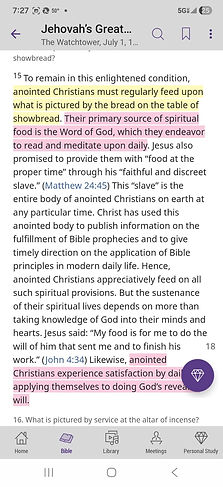

Mario’s question (1/10/26):
“So, how do you see the priestly service of the anointed while on earth?”
Before I describe my perception, I feel it is important to emphasize the purpose of the temple itself—as an arrangement to draw close to Jehovah. Jehovah loves people and wants to dwell with them and lead them by means of his holy spirit. Since sin separates people from God, the temple served as the means of reconciliation. There is sin that leads to death, and sin that does not lead to death, and Jehovah mercifully accepts petitions and redeems a guilty conscience.
Even before the Mosaic tabernacle was introduced, heads of families carried priestly responsibility by offering sacrifices for sins—Noah, Jacob, and Job are clear examples. From Abel onward, it was evident that such sacrifices were acceptable to God. Through Moses, Jehovah systematized sin offerings and established the order of presenting blood, including its entrance into the Most Holy on the national Day of Atonement, which symbolized access to communion with Jehovah. During the rest of the year, people brought their sin sacrifices to the priest, and the blood was poured out at the altar in the inner court.
Sin offerings, however, were not the only sacrifices Jehovah encouraged. Communion sacrifices carried a higher purpose within the temple arrangement. When we read the Bible with this in mind, we can find many examples where Jehovah responded with communion—sometimes through angels, messages, or direct blessings.
The account of Eli and Hannah is especially illustrative. Eli was not a perfect priest, yet Jehovah honored the arrangement. Elkanah offered communion sacrifices and gave Hannah a double portion. After they ate, Hannah prayed in close proximity to Eli, in harmony with the Mosaic arrangement where communion sacrifices were eaten with the priest who presented them at the altar. Jehovah used that moment of communion to remove Hannah’s sadness and grant her request.
With this background, we can look at anointed Christians in the first century, who experienced what was pictured by priests serving symbolically in the inner court and the Holy. Preaching and teaching are essential for bringing sheeplike individuals into the great spiritual temple so they may draw close to Jehovah. But this is not the pinnacle of the Christian journey. Dedication and baptism mark the beginning of elevation in spiritual perception.
Meaningful communion with Jehovah does not come overnight. As Jesus said, the spirit blows where it wants—you hear its sound, but you do not know where it comes from or where it goes. Even those born again at the beginning of their journey are not immediately able to recognize or master their perception of Jehovah’s communion. Hazy outlines precede clearer understanding, but this does not deny sonship. The 144,000 are identified as firstborn ones, and birth marks the beginning of a journey, not its completion.
As spiritual growth continues, some begin to perceive Jesus walking in the midst of the lampstands in the Holy. “Let the one who has an ear hear what the spirit says to the congregations.” Unless someone is anointed, it is not possible to perceive matters from the standpoint of being inside the Holy—even if a person is standing there without realizing it. Like Moses and Joshua, Jehovah sometimes must reveal that the ground on which one stands is holy.
Those who are chosen experience this awakening. We hear Jehovah’s approach through the Scriptures and congregation meetings in a distinct way—not as superiority, but as responsibility. We are called according to individual purpose, and this affects how we hear Jehovah, especially through Jesus and through others who are also called. Communion among the anointed has special value, which is why inspired expressions are tested carefully.
Now, focusing more directly on how I see the priestly service of the anointed while on earth:
Paragraph 14 of the July 1, 1996 Watchtower explains that what anointed ones perceive is not kept to themselves. This is where the bride imagery becomes helpful. We are not kings now. We serve in a supportive, priestly role—like wives who strengthen and sustain the household of their head. We do not dominate consciences or decisions. We support the body of elders and the faithful slave appointed by the Master over the household.
Proverbs 31 illustrates this well. The wife feeds, clothes, and stabilizes the household and cares for the master’s interests. I especially appreciate the term stabilize, often used by the faithful slave when sending missionaries or pioneers to areas of greater need. That stabilizing role reflects well the work of priests. Bringing people to the truth is one thing; helping them experience and understand communion with the Holy One is another level of responsibility.
This work must be done with discernment—“do not awaken love until it is inclined.” Jehovah allows time for people to grow solid on the foundation of Christ, built not merely on emotion, but on enduring God’s Word. From first hearing God’s Word to becoming a living temple—where the law is written on the heart rather than on stone—takes time.
From the moment people begin searching until they truly build something solid, there is a long journey that may include testing, opposition, and failure. Our priestly duty is to support such growth gently—to continue cleansing through God’s Word, to help others hear and do what they hear, and to be present when they fall so they can stand again.
Whether brothers bring sin offerings or communion sacrifices, it is our honor to serve them through prayer, praise of Jehovah’s excellent qualities, teaching, and encouragement. In this sense, priestly preaching does not end with those outside. It also includes teaching and shepherding among the brothers—just as Jesus entrusted Peter with the words: “Feed my little lambs… shepherd my little sheep.” In this way, priestly service continues within the congregation, nurturing those already dedicated to Jehovah.
This understanding harmonizes with Scripture:
Leviticus 10:10; Malachi 2:7; the example of Jesus; the priestly ministry of Paul; Peter’s shepherding responsibility; and John’s presentation of priestly identity—all point to priestly service as active now, expressed through teaching, intercession, and care for Jehovah’s people.
A Timely Scriptural Conversation With Gabriel
I would like to share something that helped me personally, not as an argument, but as an illustration of how Jehovah sometimes deepens communion through patience and prayer.
After our conversation on Thursday, I felt no urge to push the subject further. Instead, I chose to pause and pray, trusting that Jehovah would clarify matters in His own time. The very next day, during our scheduled cart witnessing shift, I was assigned—unexpectedly—to stand with a young brother named Gabriel. Our conversation unfolded naturally, and at one point I asked him what he had been enjoying in his personal Bible reading. Without hesitation, he mentioned Daniel’s seventy weeks.
That immediately drew my attention, especially when he focused on Daniel 9:24. Wanting to be careful and accurate, I opened the Study Bible notes, and there I saw the reference to the July 1, 1996 Watchtower on Jehovah’s great spiritual temple—a reference I had not revisited in many years. Reading it again, in that setting, after prayer and restraint, it felt less like discovering something new and more like Jehovah gently confirming something He had already been teaching me over time.
What impressed me most was not the article itself, but the way the clarification came. It did not come through debate or insistence, but through patience, obedience to assignment, an unplanned conversation, and a reminder from God’s Word encountered at the right moment. That experience strengthened my sense of communion in what the inner court represents to me—not rushing ahead, not holding back truth, but allowing understanding to mature quietly while remaining open to continued dialogue.
I share this with you because I value our conversations. For me, this experience reinforced that communion with Jehovah grows best when we give space for His spirit to work—both in us and between us.
How this experience supports the priestly service of the anointed
What happened with Gabriel helped me see more clearly how priestly service functions while the anointed are still on earth.
First, notice what did not happen. I did not receive new revelation, a private message, or direction outside of Scripture or the publications. Everything came through:
-
an assigned theocratic arrangement,
-
a conversation with a fellow brother,
-
a Scriptural discussion,
-
and a previously published Watchtower article.
That alone reflects a priestly pattern, not a prophetic one.
In the Mosaic arrangement, priests did not create truth; they handled, clarified, and applied what Jehovah had already given—often at the right moment, for the right person, in response to prayer. That is exactly what occurred here.
Second, the experience reflects intercessory priestly service, not rulership. After our conversation, I did not attempt to persuade, correct, or press you. Instead, I prayed and waited. Intercession and patience are core priestly functions. Kings act decisively; priests stand, wait, and serve at Jehovah’s pace.
Third, the clarification came through service in the inner court, not through public proclamation. The context was not a preaching talk or public teaching, but shepherding-style conversation with a brother, careful handling of Scripture, and attention to conscience. That aligns with priestly service—ministering among dedicated ones, not ruling over them.
Fourth, the way Jehovah clarified matters mirrors how priests worked in the temple:
-
the question arose from service,
-
prayer followed,
-
clarification came through the Word,
-
and understanding was strengthened without disruption to unity.
This is precisely what paragraph 14 of the July 1, 1996 Watchtower describes—anointed ones serving in the spiritual temple by handling spiritual food, prayers, and instruction while still on earth.
Finally, this experience did not elevate me above others; it increased responsibility. Priestly service does not end in certainty—it deepens accountability. Once something is clarified, it is not to be kept privately, but shared carefully, humbly, and only when appropriate.
So for me, this experience supports priestly service of the anointed in a very practical way:
-
not by authority,
-
not by rulership,
-
but by patient service, discernment, intercession, and careful use of God’s Word among the brothers.
That is why I see priestly service as a present reality for the anointed, while kingship remains future.
1/11/26 The fresh thoughts that I woke up with
The Night Watch of the Great Spiritual Temple
The High Priest of the great spiritual temple is guarding the house as well. Along with him, the priests hold watch over the entire territory of the temple. Nothing unclean is permitted to enter. For this reason, Daniel’s prophecy about the “disgusting thing” carries deep meaning for all Christians, while placing a particular responsibility on the anointed ones to remain alert and watchful.
One of the most vivid pictures that has shaped my priestly perception appears in The Watchtower, March 1, 1997, “Happy Are Those Who Stay Awake!” That article connects spiritual wakefulness with Armageddon and highlights the priestly duty shared by both the anointed and the other sheep—to stay awake, keep their garments, and guard the sanctity of Jehovah’s worship.
Coming as a Thief
4. In what manner will Jesus come to destroy this wicked system of things?
The glorified Lord Jesus Christ said: “Look! I am coming as a thief.” A thieflike coming would be sudden, at an unexpected time, when most people are asleep. When Jesus comes like a thief to destroy this wicked system, he will preserve those who are truly awake. He told John: “Happy is the one that stays awake and keeps his outer garments, that he may not walk naked and people look upon his shamefulness.” (Revelation 16:15) What is the import of those words? And how can we stay spiritually awake?
5. What arrangement for temple service existed when Jesus was on earth?
Generally, a guard would not be stripped naked if he fell asleep on the job. But that did happen at the temple in Jerusalem when Jesus was on earth and divisions of priests and Levites served at the temple in Jerusalem. It was in the 11th century B.C.E. that King David arranged Israel’s hundreds of priests and their thousands of Levitical assistants into an organization made up of 24 divisions. (1 Chronicles 24:1-18) Each division of over one thousand trained workers took its turn in handling the features of temple service at least twice a year for one full week at a time. At the Festival of Booths, though, all 24 divisions were on hand for duty. Extra help was also needed at Passover festivals.
6. To what may Jesus have alluded when he said, “Happy is the one that stays awake and keeps his outer garments”?
When Jesus said, “Happy is the one that stays awake and keeps his outer garments,” he may have alluded to a procedure then followed that involved guard duty at the temple. The Jewish Mishnah says: “The priests kept watch at three places in the Temple: at the Chamber of Abtinas, at the Chamber of the Flame, and at the Chamber of the Hearth; and the levites at twenty-one places: five at the five gates of the Temple Mount, four at its four corners inside, five at five of the gates of the Temple Court, four at its four corners outside, and one at the Chamber of Offerings, and one at the Chamber of the Curtain, and one behind the place of the Mercy Seat [outside the rear wall of the Most Holy]. The officer of the Temple Mount used to go round to every watch with lighted torches before him, and if any watch did not stand up and say to him, ‘O officer of the Temple Mount, peace be to thee!’ and it was manifest that he was asleep, he would beat him with his staff, and he had the right to burn his raiment.”—The Mishnah, Middoth (“Measurements”), 1, paragraphs 1-2, translated by Herbert Danby.
7. Why did priests and Levites on guard duty at the temple need to stay awake?
The many Levites and priests of the serving division stayed awake all night to keep guard and to prevent anyone unclean from entering the temple courtyards. Since the “officer of the Temple Mount,” or “the captain of the temple,” made the rounds of all 24 stations during the watches of the night, each watchman had to stay awake at his post if he did not want to be caught off guard.—Acts 4:1.
8. What are the Christian’s figurative outer garments?
Anointed Christians and their fellow servants need to stay spiritually awake and keep on their figurative outer garments. These are the outward evidences of our appointment to the ministry at Jehovah’s spiritual temple. In recognition of this, we have God’s holy spirit, or active force, to help us perform our duties and carry out our privileges as Kingdom proclaimers. Falling asleep at our posts as God’s ministers would put us in danger of being caught by Jesus Christ, the Captain of the great spiritual temple. If we were spiritually asleep at that time, we would figuratively be stripped naked and would have our symbolic garments burned. So how can we stay awake spiritually?
It stirred my interest imaging even sharper how was it by using the power of AI I discovered the following;
The three priestly chambers
The priestly watch was kept in three places, named in Hebrew traditions as:
1. Beit Avtinas (House/Chamber of Abtinas)— Guarding the Incense
Guarding the House of Avtinas — Protecting the Sanctity of Approach
One of the priestly watch stations mentioned in Jewish tradition was connected with the House of Avtinas (Beit Avtinas). This family was entrusted with the preparation of the sacred incense and with preserving the specialized knowledge associated with it. That assignment alone explains why this location required constant guarding.
Jehovah strictly forbade the use of holy incense for personal or common purposes. The formula itself was protected, and misuse was punishable by death. Incense represented something uniquely reserved for God—the prayers of His people rising acceptably before Him.
Incense could not be improvised.
It could not be duplicated.
It could not be enjoyed privately.
It belonged exclusively to Jehovah.
The seriousness of this boundary was established unmistakably from the beginning. Nadab and Abihu, the sons of Aaron, entered the holy place and offered unauthorized fire—something Jehovah “had not commanded.” Fire came out from before Jehovah and consumed them instantly. Their error was not casual irreverence; it was approaching Jehovah on their own terms, with fire that did not originate from His arrangement.
This event established an enduring principle:
Access to Jehovah is never self-defined.
The problem was not incense itself, nor priestly status, but the source and intention behind the offering. Wrong fire in the holy place meant that the boundary between Jehovah’s holiness and human initiative had been crossed.
For this reason, guarding the House of Avtinas was not merely about protecting materials or preserving secrecy. It was about protecting the sanctity of approach. Incense represented communion, and communion required obedience, reverence, and alignment with Jehovah’s will.
Jehovah reinforced this responsibility immediately after the death of Nadab and Abihu. Speaking directly to Aaron, He said:
“Do not drink wine or other alcoholic beverages, you and your sons with you, when you come into the tent of meeting, so that you will not die. It is a permanent statute for your generations. This is to distinguish between the holy thing and the profane and between the unclean thing and the clean, and to teach the Israelites all the regulations that Jehovah has spoken to them through Moses.” (Leviticus 10:9–11)
These words reveal that priestly service required clarity of mind, spiritual sobriety, and discernment. The priests were not merely offering sacrifices; they were entrusted with the responsibility to separate what is holy from what is common and to teach Jehovah’s standards to the people. The tragedy of Nadab and Abihu showed that even appointed servants could not approach Jehovah casually or according to personal impulse. Communion with Jehovah demanded reverence and obedience.
From the very beginning of the tent of meeting, Jehovah made clear that incense was not for personal spirituality or self-directed worship. It symbolized prayers that were acceptable to Him—offered according to His will, in His way. The account of Nadab and Abihu stands as a lasting testimony that unauthorized fire—self-willed worship—could not be tolerated in Jehovah’s presence.
In the same way, all who are permitted to serve within Jehovah’s great spiritual temple—whether anointed ones or others who draw close—must remain watchful regarding the prayers of the holy ones. Prayer is a central expression of communion with Jehovah, and it must be kept clean, reverent, and aligned with His standards. The apostle Paul echoed this priestly responsibility when he wrote that he desired men in every place to pray, lifting up loyal hands, without wrath and without disputing.
Thus, guarding the temple has always meant more than physical oversight. It involves spiritual alertness, discernment, and responsibility—ensuring that what is offered to Jehovah, especially prayer, remains holy and acceptable.
2. The House of the Flame — Preserving the Fire
The House of the Flame (Beit HaNitzotz) safeguarded something just as essential as incense: fire.
In ancient times, fire was not easily produced. More importantly, the fire used in temple service was not common fire. The Scriptures indicate that Jehovah himself originally ignited the altar fire, and that fire was never to be extinguished. It was to be preserved continually as part of His arrangement.
Fire was used:
-
on the altar of burnt offering,
-
in the preparation of incense,
-
in maintaining continual sacrifice,
-
and as a visible sign of divine acceptance.
If the fire went out, service stopped.
For this reason, the House of the Flame represented continuity. Even at night—when no public sacrifices were being offered—the flame remained alive. Guarding it required vigilance, not excitement. It was not dramatic work. It was faithful, repetitive, and quiet responsibility.
Spiritually, this chamber speaks of maintaining zeal without noise. Fire symbolizes endurance, illumination, and purification. The priests assigned to guard the flame were not preaching, sacrificing, or teaching publicly. Yet without their watch, nothing else in the temple could continue.
This teaches that priestly service often consists in preserving what others take for granted—spiritual warmth, readiness, and the quiet assurance that Jehovah’s arrangement remains alive and operative.
The apostle Paul reflected this same principle when he urged Timothy: “For this reason I remind you to stir up like a fire the gift of God that is in you.” (2 Timothy 1:6) Paul did not speak of creating something new, but of keeping alive what had already been given. That is precisely the work represented by the House of the Flame—not public display, but faithful preservation.
The Flame and Revelation — Lamps That Must Not Go Out
The meaning of the House of the Flame reaches beyond the Mosaic temple and finds a clear echo in the book of Revelation.
There, the risen Jesus is seen walking among seven lampstands. These lampstands are not decorative; they are functional. They must burn. Their light must remain. Jesus does not merely observe them—he inspects them. He trims, corrects, and warns. In one case, he even says that if repentance does not occur, he will remove the lampstand from its place.
This imagery aligns perfectly with the responsibility symbolized by the House of the Flame.
A lampstand that no longer burns has lost its purpose. Likewise, a congregation—or an individual—may still possess structure, activity, and outward form, yet lack the inner fire that sustains spiritual life. Fire must be preserved before light can shine.
Importantly, Revelation does not present this fire as emotional enthusiasm or outward activity. Instead, it is connected with endurance, faithfulness under pressure, purity of devotion, and obedience to Christ’s direction.
Just as in the ancient temple the fire was guarded quietly at night, so in Revelation the spiritual flame is preserved during periods of darkness, trial, and waiting. This reinforces the idea that priestly service is not always visible, but it is always essential.
In this way, guarding the fire was an indispensable priestly task. It ensured that when the moment came for sacrifice, incense, or service, everything was ready. Without the flame, no offering could proceed. The fire was already present—the responsibility was simply to keep it alive.
This understanding of guarding the fire does not replace Jehovah’s organizational arrangements for shepherding and oversight. Rather, it supports them.
Just as the fire in the ancient temple was not the altar itself, yet without it no sacrifice could be offered, priestly service today helps preserve the spiritual vitality on which congregation activity depends. Elders shepherd and teach according to Jehovah’s arrangement, while priestly service works quietly to maintain endurance, prayerfulness, and devotion.
This work does not confer authority or operate independently. It strengthens what Jehovah has already established. Like guarding the fire at night so the altar could function by day, priestly service helps ensure that when shepherding takes place, the congregation is spiritually ready.
It is unseen, but essential—and always in harmony with Jehovah’s arrangement.
3. The Chamber of the Hearth — Warming the Heart
The Chamber of the Hearth (Beit HaMoked) was a place where priests could warm themselves during the long night watches. It was simple and functional—a fire pit, seating, and shelter from the cold—yet spiritually profound.
This chamber likely held the quietest and deepest moments of temple life.
Here, priests and Levites spoke softly—about the Law, about service, about endurance, doubts, and hope. These were men who stood guard together night after night. They shared fatigue and responsibility, reverence and silence. The warmth found here was not merely physical; it was spiritual.
The fire in the hearth warmed their bodies,
but conversation around it warmed their faith.
This chamber reminds us that Jehovah’s service was never meant to be a cold or isolated duty. Even within strict holiness, there was room for fellowship, reflection, and mutual strengthening. The hearth did not replace the altar, but it sustained those who served at the altar.
Spiritually, the Chamber of the Hearth represents the inner life of faithful servants—the place where burdens are shared, understanding matures, and hearts remain alive. It is here that priestly perception deepens, not through ritual alone, but through faithful presence, patience, and shared reverence before Jehovah.
This pattern finds its fulfillment both on an individual level and within the holy temple formed by Christ’s body—the anointed Christians whose hearts are awakened and gradually transformed from stone into living hearts responsive to Jehovah.
A Unified Picture of Priestly Watchfulness
I often imagine the warmth of the spiritual communion in the Chamber of the Hearth, and then the quiet moment when the captain of the Temple begins his night walk—accompanied by a few associates, torches in hand. They do not leave the warmth behind; they carry it with them. The conversations continue as they move, sometimes the same themes, sometimes new ones, shaped by what each watch requires.
As they pass from station to station, they find priests and Levites awake at their posts. A greeting is exchanged. A few words are spoken. Sometimes a reminder, sometimes encouragement, sometimes nothing more than shared recognition. Yet each encounter strengthens those on watch. The flame carried on the torches does not replace the altar fire—but it reassures, illuminates, and confirms that the temple is alive and guarded.
I see my spiritual communion with brothers and sisters through this same lens. Not as inspection, not as instruction from above, but as shared watchfulness. Conversations that arise naturally—often quietly—carry warmth, clarity, and endurance. They do not interrupt assigned service; they sustain it. They do not replace organized shepherding; they complement it by strengthening hearts.
Yes, this is how I understand a portion of priestly responsibility: remaining awake together, sharing light without noise, and helping one another keep the flame alive during the night.
Together, these three stations reveal the full scope of priestly service:
-
The House of Avtinas guarded the purity of communion.
-
The House of the Flame preserved continuity and readiness.
-
The Chamber of the Hearth sustained the servants themselves.
None replaced the others. Each was essential. And all were necessary for Jehovah’s worship to remain alive, clean, and enduring.
In this way, temple guardianship was not merely about guarding space—but about guarding prayer, zeal, and the heart itself.